
The Connection Between Hunting and Love of Nature
Theodore Roosevelt the Hunter, At Home

Theodore Roosevelt is known for his adventurous hunts across the country and the world—like the bear hunt in the Louisiana canebrakes in 1902 where he acquired his “Teddy” nickname and the 1909–1910 Smithsonian-Roosevelt expedition to Africa. But to better understand Roosevelt the hunter, you have to start at home.
Both his home of Sagamore Hill and Pine Knot, the presidential retreat near Charlottesville, Virginia, reveal his character as a hunter. Although he did not go after big game like moose, elk, or rhino there, these places reveal another side of Roosevelt the hunter.
Sagamore Hill was filled with hunting trophies and hunting books. In fact, as Roosevelt wrote in a 1895 letter to journalist Julian Ralph, he believed his library was “without question the best library” for hunting books and books of outdoor life in the fields and the woods.
It might be tempting to think that of course hunting was emphasized inside the home because Roosevelt loved killing animals, but that statement couldn’t be further from the truth. In Roosevelt’s mind, one couldn’t be an ethical hunter without appreciation for the flora and fauna.
It might surprise you to discover that the following line is found at the beginning of the chapter entitled “At Home” in Theodore Roosevelt’s Outdoor Pastimes of An American Hunter (1905): “All hunters should be nature lovers.” He then follows up with a sentence about his hope that “days of mere wasteful, boastful slaughter” are gone and that the hunter will first and foremost seek to preserve wildlife—big and small.
What follows that sentence is Roosevelt’s detailed explanation of the birds, other animals, and pets found at Sagamore Hill for the rest of the chapter. He discusses killing two animals at Sagamore Hill—a possum and a raccoon—but another possum he spared because he played with it briefly and decided it would be “too much like murder” to kill it in cold blood.
Sagamore Hill was where Roosevelt lived out his love for nature—riding horses, canoeing, hiking, camping, listening to birdsong, walking, and more. It was a place where he could be out in nature without needing to hunt.
Roosevelt’s valet, James Amos, remembered that no one was allowed to hunt birds at Sagamore Hill and that the depiction of Roosevelt as delighting in “bloodthirsty pursuit of wildlife” was inaccurate.
Although Roosevelt mostly didn’t hunt at Sagamore Hill, the presidential retreat of Pine Knot, a rustic cabin where he would spend several days away while president, was different. There he both enjoyed nature and occasionally hunted.
In fact, Pine Knot was where Roosevelt killed his first turkey in early November 1906 as he related in a letter to Bill Sewall, whom he calls “Friend William”: “I killed a turkey there [at Pine Knot] this fall, the first I ever shot; and the only one I have ever shot at.”
This wasn’t the first time Roosevelt had attempted to hunt turkey. He had several earlier failed attempts while president. Shortly after becoming president in 1901, he tried, writing to his son Ted on November 25, 1901, “I sat three hours in a blind waiting for a turkey but none came.”
The next year, he also failed while hunting with Surgeon General Presley Marion Rixey. As he related in a November 6, 1902, letter to his son Ted, “I got no turkeys on my hunt, and your suppositions as to what the hunt would turn out were verified . . .”
Roosevelt even joked in a speech delivered on November 1, 1902, in Manassas, Virginia, about his failed turkey hunt that day: “I regret to state that the turkeys did not materialize.” (Initially, the hunt had been planned for October 15, but the date had to be moved to November 1—the first day it was legal.)
And even Roosevelt’s successful hunt at Pine Knot in 1906 didn’t come easily. As he details in the revised 1908 edition of Outdoor Pastimes of an American Hunter, he spent three days rising between 3:00 a.m. and 5:00 a.m. while the frost was heavy before he succeeded in bagging a turkey.
Dick McDaniel, a neighbor, acted as Roosevelt’s guide, and Jim Bishop, “a man who had hunted turkeys by profession,” joined them on the last day when Roosevelt finally got a turkey after thirteen hours of hunting.
As Roosevelt wrote in to a letter to Frederick W. Whitridge, “I have just shot a wild turkey myself, but only one . . .” Even though he only killed one turkey, Roosevelt was quite delighted by his success and mentioned it in several letters.
His letter to his son Kermit was the most detailed, including information like the fact that TR rose progressively later each of the three days—3:00 a.m. on the first, 4:00 a.m. on the second, and 5:00 a.m. on the third—as well as the fact that he killed the turkey with a 10-gauge shotgun.
The press didn’t miss its opportunity to highlight Roosevelt’s successful turkey hunt in a cartoon on November 3, 1906, entitled “Couldn’t Fool Him.” (Roosevelt’s letter to John Campbell Greenway confirms that he shot the turkey on Saturday, November 3, 1906.)
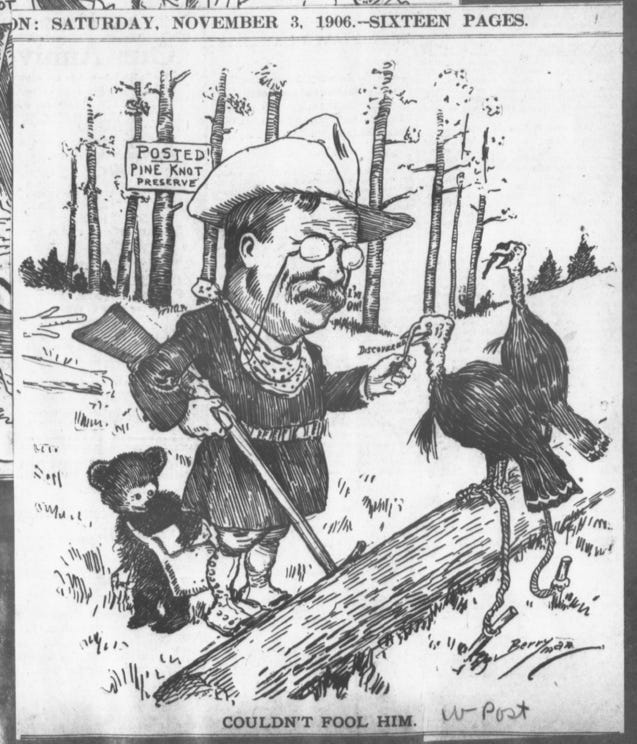
Although Roosevelt was delighted by finally killing a turkey, in Outdoor Pastimes of an American Hunter, he made his hunting ethics clear to readers that his hunting at Pine Knot was not wanton killing but instead provided food for the table: “There are plenty of quail and rabbits in the fields and woods near by, so we live partly on what our guns bring in; and there are also wild turkeys.”
Besides considerations of ethical hunting, proper hunting attire is another important topic of conversation. Although not directly related to Roosevelt and home, I couldn’t forego the opportunity to briefly discuss some of Roosevelt’s hunting attire.
I did not find any instances of Roosevelt wearing buffalo plaid—the standard hunting attire prior to blaze orange. (If you’re interested learning more about best copyediting practices for describing hunting attire, check out the latest issue of my sister Rebekah Slonim’s editing newsletter, Strike-Through.)
But I do believe he referenced buffalo plaid in a letter to his friend Robert Harry Munro Ferguson, who expressed interest in joining the Rough Riders in 1898: “I should take down a rubber blanket and your own plaid.”
As a Boys’ Life magazine from 1919 observed, “Now then, remember that these lumbermen work all winter in the cold North Woods and, to protect themselves from the cold, wear clothes of cloth cut from blankets.” These blankets were often called “buffalo plaid,” so that’s what I believe Roosevelt is referencing.
Rather, the hunting attire that the public often associated Roosevelt with was khaki or buckskin. The same Boys’ Life magazine said, “Gen. Custer, Col. Roosevelt, Dr. Horniday [I believe this is referencing William Temple Hornaday] and all the old time wilderness men wore buck-skin hunting clothes and many of them still wear buck-skin shirts in the woods.”
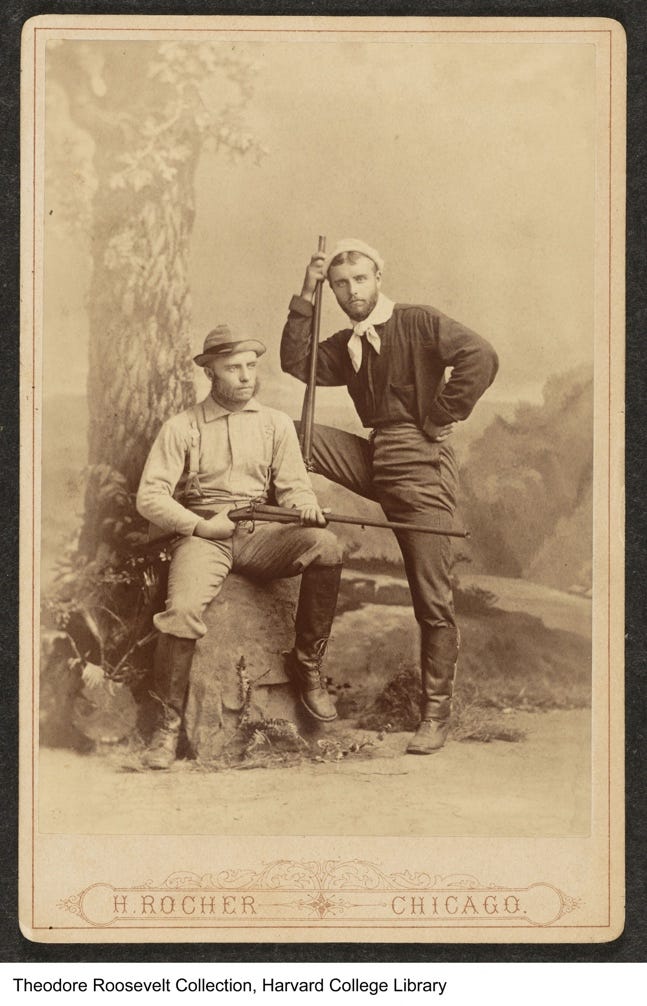
Unsurprisingly, the most famous picture of Roosevelt in hunting attire is him in buckskin, but I found two others that show a different side. The first is from around 1880 with his brother, Elliott.
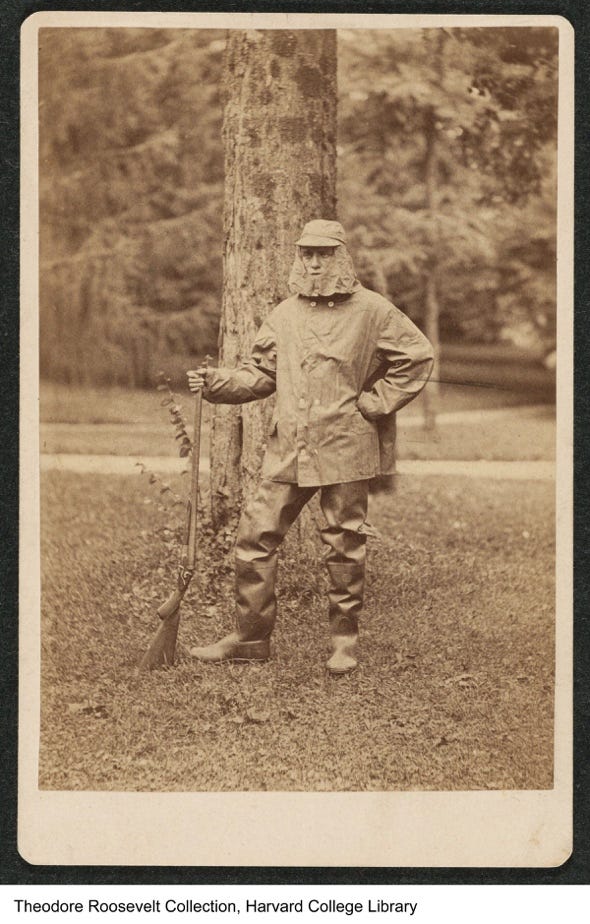
The second is one of the funniest pictures I have ever seen of Roosevelt. It bears the title “in hunting gear”—and I thought maybe it would be Roosevelt in buffalo plaid, but it certainly is not!
With that, I’ll conclude this look at Roosevelt the hunter at home. For those of you who shared the Missing Pieces post about books in January (even if you want to do it today!) and liked the comment in the chat, I will pass along January’s trivia game about books.
And for those of you who want to share this Missing Pieces post about hunting, make sure you like the comment in the chat for a trivia game about Theodore Roosevelt and hunting that I’ll pass along at the end of this month or early next month.