
“Good for the Split Infinitive!”
Roosevelt, The Editor

As I have written before, census records are an incredible resource to learn about people of the past, including famous people like Theodore Roosevelt. I’m guessing, though, that if you’re a Tedhead, you are probably thinking that there isn’t anything you could learn about Roosevelt from the census that you don’t already know. But you might be wrong!
If you were guessing, what do you think Roosevelt’s occupation is listed as on the 1910 census? Maybe ex-president? Or perhaps naturalist or explorer due to the 1909-1910 Smithsonian-Roosevelt expedition to Africa? The answer might surprise you.
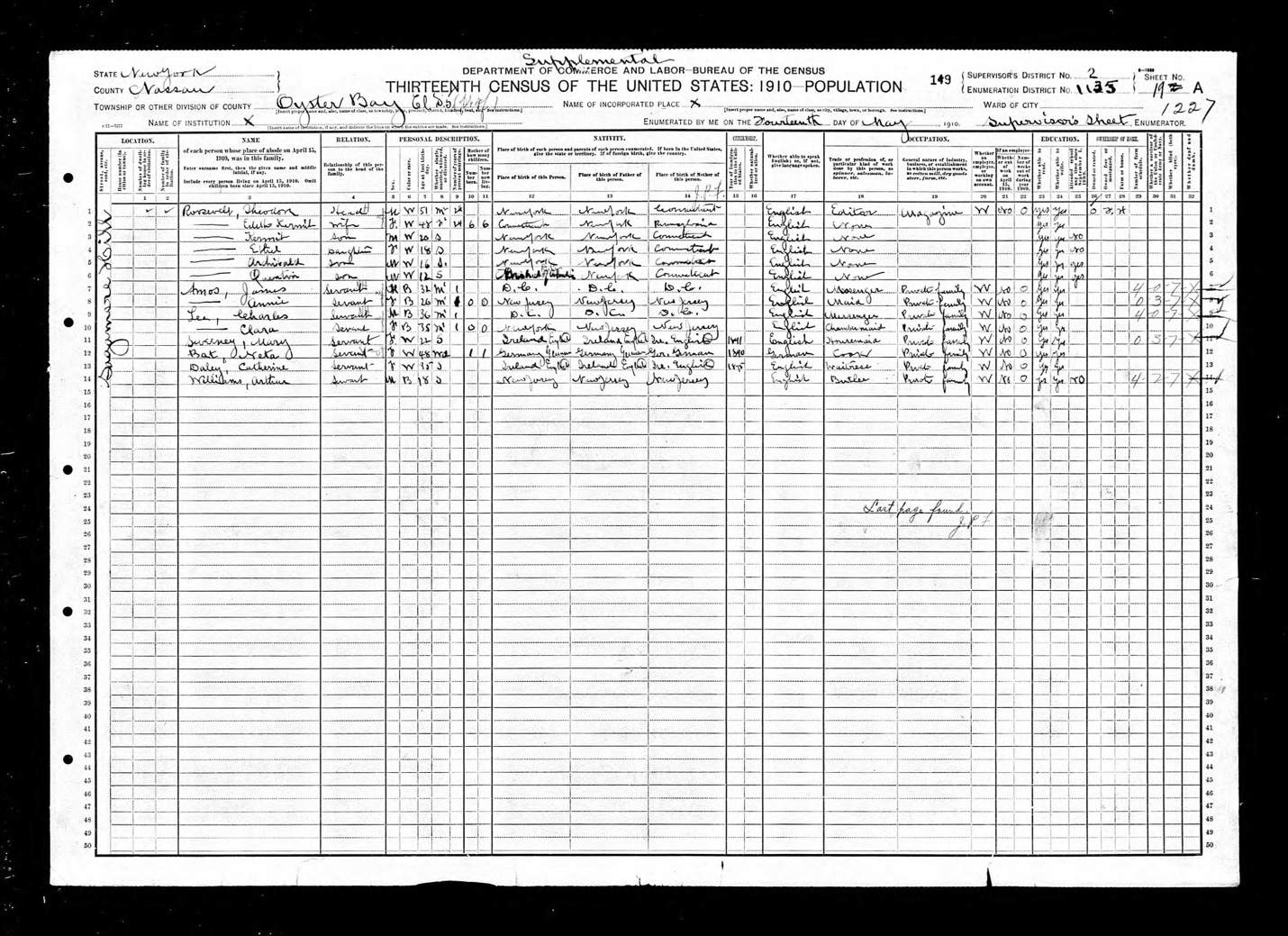
Editor.
As the Theodore Roosevelt Center notes, Roosevelt was the “readingest” (see January 2026’s Missing Pieces issue) and “writingest” president. He authored over 35 books, hundreds of articles, and an estimated 150,000 letters.
Brander Matthews, an academic and literary critic of Roosevelt’s time, suggested, “Roosevelt’s style is firm and forthright, and its excellence is due to his having learnt the lesson of the masters of English. He wrote well because he had read widely and deeply—because he had absorbed good literature for the sheer delight he took in it.”
Roosevelt could also be called the “editingest” president since good writing and editing are two sides of the same coin. To produce high-quality content as a writer, one must take the time to edit. Theodore Roosevelt not only knew this truth but also lived it out.
In a collection of excerpts from Roosevelt’s Autobiography published shortly after Roosevelt’s death, Maurice Garland Fulton, a professor of English at Indiana University, went into great detail about Roosevelt’s editorial style in the introduction.
Fulton observed that Roosevelt was a thorough editor of his own work. According to Fulton, Roosevelt once told a friend, “No one knows how much time I put into my articles for The Outlook.”
Roosevelt was known for being a man of action, so one might assume he hurriedly composed material. That is only partially correct. As is probably no surprise, he paced up and down the room when dictating a first draft to a stenographer, but then he painstakingly worked through the typed draft, as Francis E. Leupp remembers.
As Father Zahm, a member of the Roosevelt-Rondon expedition to Brazil, wrote, “He put into his magazine work far more thought and labor than is usually imagined. After an article was written, he revised it carefully, correcting, changing, amplifying, and excising until certain of the pages were scarcely decipherable.”
Much could be written about Roosevelt’s grammatical style, but I will restrain myself to discuss just one topic: his penchant for split infinitives.
As is the case today, Roosevelt’s contemporaries were divided regarding the use of split infinitives. Leupp saw Roosevelt’s use of them as a defect, but others held up Roosevelt’s writing as an example of well-used split infinitives.
Interestingly, Warner Taylor, who applauded Roosevelt’s use of split infinitives, pointed to a sentence from his The Winning of the West, the same book that William Peterfield Trent suggested had “[t]oo great use of the split infinitive.”
This was not a grammatical oversight. Roosevelt actually relished the opportunity to use split infinitives. Upon learning that Thomas Lounsbury, literary historian and professor of English at Yale University, approved of them, Roosevelt enthusiastically praised them in a March 1904 letter.
“Good for the split infinitive! Here have I been laboriously trying to avoid using it in a vain desire to look culture; and now I shall give unbridled rein to my passions in the matter.”
William Draper Lewis, first full-time dean of the University of Pennsylvania Law School, also recalls a specific instance where Roosevelt clearly indicated his predilection for using split infinitives.
Roosevelt had invited some people to the North Room at Sagamore Hill to go through the language in one of his manuscripts and offer constructive criticism about the wording. The paragraph dealing with “a critical political matter” had fostered a lot of discussion.
When the discussion seemed close to the end, Roosevelt asked if anyone had any final feedback. Harvard law professor Arthur Dehon Hill raised one more objection. When Roosevelt asked what it was, Hill replied, “Oh nothing; merely a split infinitive.”
Roosevelt in turn responded with “mock ferocity”: “I like split infinitives—on proper occasion. This particular split is the only thing you fellows have left me in this, one of my greatest works of art. Do you really wish me to take it out?”
The whole group of individuals, including Hill, erupted in laughter and a chorus of no’s. Unfortunately, since we don’t know the title of the manuscript in question, I can’t figure out if the split infinitive stayed in or not.
Although Roosevelt incorporated split infinitives regularly, his co-author of Hero Tales from American History (1895) and one of his closest friends—Massachusetts Senator Henry Cabot Lodge—didn’t see eye-to-eye with him on this grammatical choice.
As former Ohio Senator Joseph B. Foraker wrote in his memoir of Lodge, “A split infinitive gave him positive pain, no matter who split it . . .” Presumably that extended to Roosevelt himself!
If you’re wondering—as I did!—who won the split infinitive battle in Hero Tales, the answer appears to be Lodge. When I asked ChatGPT to count the number of split infinitives that appeared in the text, it said zero.
Although I didn’t verify that result myself by reading the entire book looking for split infinitives (and I remain an AI skeptic), I do think ChatGPT is more likely than not to be correct in this instance since it had a clearly defined summary task.
In case you’re wondering if it accurately understood the grammatical concept of a split infinitive, it did appear to, as it correctly identified a split infinitive in the first chapter of volume one of Roosevelt’s The Winning of the West: “Even if they were too broad-minded and far-seeing to feel thus, they yet were unable to fully appreciate the magnitude of the interests at stake in the west.” (emphasis added)
While Lodge may have gotten his way in Hero Tales, that didn’t stop Roosevelt from incorporating split infinitives in his writing after he became president, which was somewhat controversial.
Even so, as the December 20, 1906 edition of the Journal of Education observed: “Mr. Roosevelt is criticised [sic] because he sometimes splits an infinitive, but he will accomplish more with one sentence with its split infinitive than all of these petty fellows will acomplish [sic] with all they could write if they worked together and worked all their lives.”
No matter which camp you fall into regarding the split infinitive—Lodge’s or Roosevelt’s—almost anyone would agree that Roosevelt accomplished much with his writing, split infinitives notwithstanding.
If you’re interested in learning more about the split infinitive as a grammatical element, check out the latest issue of my sister Rebekah Slonim’s editing newsletter, Strike-Through. A copyeditor with over ten years of experience in the field, she weighs in on whether or not we should be following in Theodore Roosevelt’s example regarding split infinitives.